


Everything You Need To know
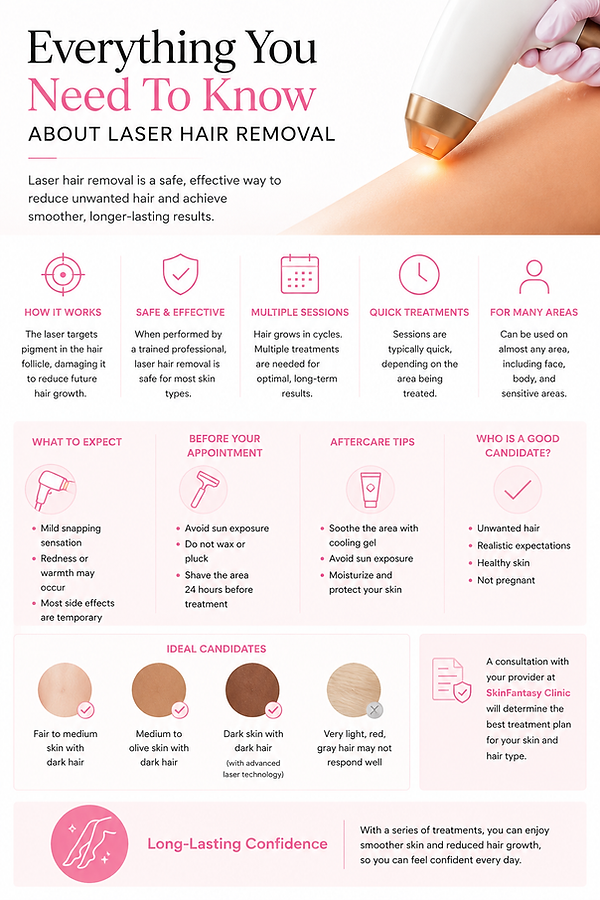
How Does Laser Hair Removal Work?
Laser hair removal works by directing a concentrated beam of light into the hair follicle. The pigment (melanin) inside the hair absorbs the light, which converts into heat. This heat damages the follicle and significantly slows or prevents future hair growth while minimizing damage to the surrounding skin.
Because not all hairs are growing at the same time, multiple treatment sessions are needed for the best results.
At SkinFantasy Clinic in downtown Toronto, laser hair removal treatments are customized based on your skin tone, hair color, treatment area, and goals to maximize effectiveness while prioritizing safety.
The Science Behind Laser Hair Removal
Laser hair removal is based on a principle called selective photothermolysis.
Although the name sounds technical, the concept is simple.
The laser is designed to target the pigment inside the hair—not the surrounding skin.
Here's what happens during treatment:
-
The laser emits a specific wavelength of light.
-
Melanin inside the hair absorbs that light.
-
The light energy turns into heat.
-
The heat damages the hair follicle.
-
The follicle becomes less able to grow new hair.
This process is what leads to long-term hair reduction over a series of treatments.
Why Does the Laser Target Hair?
Hair contains a natural pigment called melanin.
Melanin acts like a magnet for laser energy.
Dark, coarse hairs usually contain more melanin, making them easier for the laser to target.
Once the laser energy reaches the follicle, enough heat is produced to disrupt future hair growth while the surrounding skin remains protected through carefully selected treatment settings and cooling technology.
Why Are Multiple Sessions Needed?
This is one of the most common questions people ask.
The answer lies in the hair growth cycle.
Your hair is constantly moving through different stages:
1. Anagen (Growth Phase)
This is the stage where the hair is actively growing and attached to the follicle.
Laser hair removal works best during this phase because the follicle is directly connected to the hair.
2. Catagen (Transition Phase)
Hair growth slows and the follicle begins to shrink.
Laser treatment is generally less effective during this stage.
3. Telogen (Resting Phase)
The hair eventually sheds and a new growth cycle begins.
Hair in this stage responds poorly to laser treatment.
Because only a portion of your hairs are in the active growth phase during each appointment, several sessions are necessary to treat different follicles as they enter the ideal stage.
How Many Hairs Are Growing at One Time?
Most people are surprised to learn that only a percentage of their hair is actively growing at any given moment.
For example:
-
Some follicles are actively growing.
-
Some are resting.
-
Others are preparing to shed.
That's why one treatment cannot permanently reduce every hair.
Each appointment targets a different group of active follicles.
What Happens to the Hair After Treatment?
Immediately after treatment, the hair doesn't disappear.
Instead:
-
The follicle has been damaged.
-
The treated hair remains in place temporarily.
-
Over the next 1–3 weeks, the treated hairs gradually shed.
Many first-time clients think the hair is growing back during this stage, but it is actually the treated hair working its way out of the follicle.
Does the Hair Grow Back?
Some follicles stop producing hair completely.
Others may eventually produce:
-
finer hair
-
lighter hair
-
slower-growing hair
Hormones, genetics, age, and certain medical conditions can influence future hair growth.
For this reason, some people choose occasional maintenance treatments after completing their initial series.
Does Laser Destroy the Hair Follicle?
Laser hair removal damages the follicle enough to significantly reduce its ability to produce hair.
Some follicles become permanently inactive, while others may recover partially over time.
This is why the procedure is commonly described as long-term hair reduction rather than guaranteed permanent hair removal.
Why Is Hair Color Important?
Laser energy targets melanin.
Generally:
Dark Hair
Dark brown and black hair usually respond very well because they contain a higher concentration of pigment.
Blonde Hair
Blonde hair contains much less melanin, making it more difficult for many laser systems to detect.
Red Hair
Red hair often responds less predictably because of its unique pigment composition.
Gray or White Hair
White and gray hairs contain little to no melanin, so traditional laser hair removal is usually not effective for these hairs.
A consultation can help determine whether laser treatment is likely to be effective based on your individual hair characteristics.
Does Skin Tone Matter?
Modern laser technology has made treatment possible for a much wider range of skin tones than in the past.
Different laser wavelengths are better suited to different skin types.
Using appropriate technology and treatment settings helps maximize effectiveness while reducing the risk of unwanted side effects.
At SkinFantasy Clinic, every consultation includes an assessment of your skin tone and hair type so that treatment parameters can be selected appropriately.
Why Doesn't Laser Work After One Session?
Imagine trying to remove every weed from a garden when only some are visible above the soil.
That's similar to hair growth.
Only hairs in the active growth phase respond optimally to laser treatment.
Each appointment treats a different group of follicles as they enter that phase.
Consistency is one of the biggest factors in achieving good results.
What Factors Affect Results?
Several factors influence how well laser hair removal works.
These include:
-
Hair color
-
Hair thickness
-
Skin tone
-
Hormonal conditions (such as PCOS)
-
Genetics
-
Treatment area
-
Laser technology
-
Following the recommended treatment schedule
Because every person is different, treatment plans should be individualized rather than using the same settings or schedule for everyone.
How Long Do Results Last?
Many people experience a significant reduction in hair growth after completing their treatment plan.
Remaining hairs are often:
-
thinner
-
softer
-
lighter
-
slower-growing
Maintenance sessions may be recommended depending on hormonal changes, genetics, or the treatment area.
Is Laser Hair Removal Safe?
When performed by trained professionals using appropriate equipment, laser hair removal is generally considered a safe cosmetic procedure.
Safety depends on factors such as:
-
selecting suitable treatment settings,
-
evaluating your medical history,
-
considering medications and recent sun exposure,
-
and providing proper aftercare instructions.
At SkinFantasy Clinic, each client receives a consultation before treatment to help ensure the procedure is appropriate for their individual needs.
Frequently Asked Questions
1- Does laser remove the hair immediately?
No. Treated hairs usually shed naturally over the following one to three weeks.
2- Why do I still have hair after my first treatment?
Only hairs that are in the active growth phase respond best during each session. Additional treatments target follicles as they enter that phase.
3- Can laser stop hair growth forever?
Laser hair removal provides long-term hair reduction. Some follicles may become inactive permanently, while others can produce finer hair over time.
4- Does laser work on every hair color?
Laser generally works best on darker hair because it contains more melanin. Blonde, red, gray, and white hairs may respond less effectively depending on the technology used.
5- Why do treatments need to be spaced several weeks apart?
Spacing allows new groups of hair follicles to enter the active growth phase, making them more responsive to treatment.
Conclusion
Laser hair removal works by using carefully controlled light energy to target the pigment inside the hair follicle. Over a series of treatments, this process significantly reduces hair growth, leaving many people with smoother skin and less need for shaving or waxing.
Understanding how the treatment works—and why multiple sessions are necessary—can help you set realistic expectations and get the best possible results.
If you're considering laser hair removal, SkinFantasy Clinic in downtown Toronto offers personalized consultations to assess your skin type, hair characteristics, and treatment goals before creating a customized treatment plan.